Curated by Aika Goel & Kayla Rubenstein
This exhibit examines the paradox that though the United States championed the Universal Declaration of Human Rights, both before and after its passage, the U.S. not only permitted but facilitated a cultural genocide towards Native Americans through boarding schools that children were forced to attend.
Tens of thousands of Native American children were forcibly taken—through violence or other coercive tactics—from their homes and sent to one of 523 government-funded boarding schools. Within these schools, children were subjugated to practices that sought to erase their heritage. From cutting hair—a culturally significant part of many Native Americans’ identity—to forcing students to convert to Christianity, these boarding schools forced a large number of children to renounce their culture. Over 500 children died within these schools due to disease, injuries, and abuse. Though the cultural genocide of Native Americans extended into Canada, this exhibit will focus specifically on the United States. Each image underscores a different perspective of cultural genocide and forced assimilation as children are coerced into joining the American working class. The layout of this exhibit takes you through the seemingly two options students had: assimilate or die.
The larger phenomenon of cultural genocide is not contained to North America. Cultural genocide is a subsect of genocide that specifically targets the extermination of a specific nation’s or ethnic group’s cultural identity. To accomplish this, the group enacting the cultural genocide targets spiritual, national and/or cultural destruction. Cultural genocide is neither rare nor a relic of the past, from the Armenians of 1915 to today’s Chinese Uyghur Muslims.
The exhibition seeks to underscore how death is not the only manner in which cultures face extinction. Cultural genocide remains a prevalent threat; remembering the past and focusing on the future allows us to combat these human rights abuses.
John N. Choate
Tom Torlino – Navajo. As He Entered School in 1882 (L). As He Appeared Three Years Later (R).
(L): October 21, 1882, (R): 1885
Black & White “Before-After” Photographic Portraiture (Reproduction)
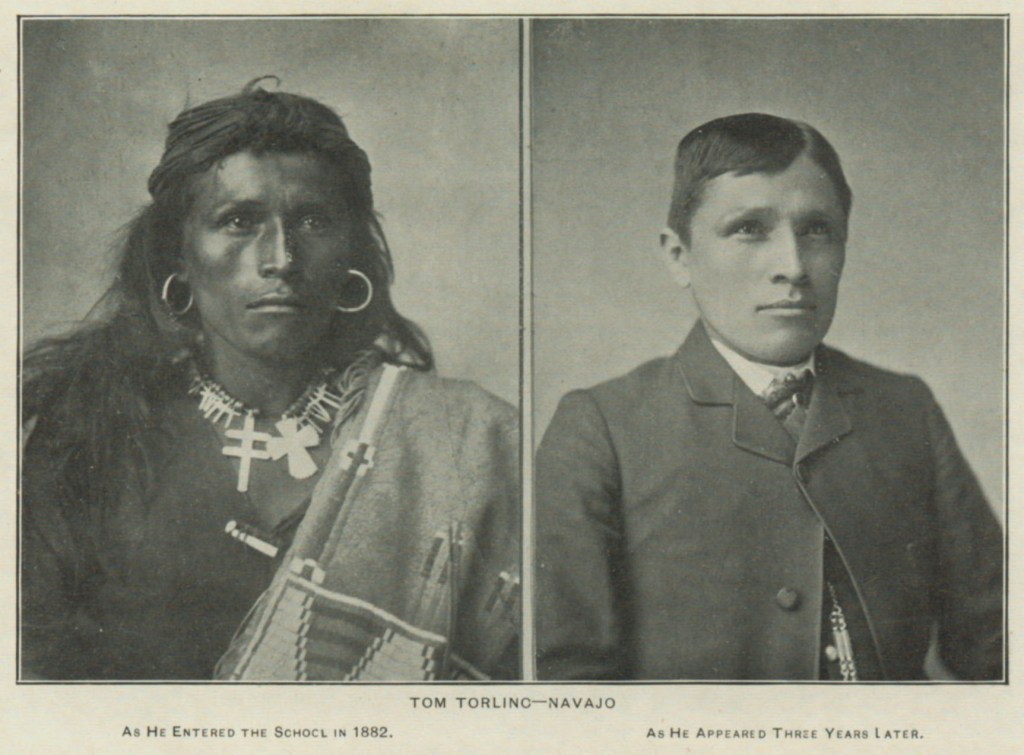
Carlisle Indian Industrial School chronicled its “civilizing” effects through before-after photography. In “before” portraits, Choate staged students in Indigenous attire and manipulated studio lighting to darken skin tones, accentuating cultural prejudices. In “after” portraits, he intensified the lighting to brighten skin tones, showcasing their “correct” evolution into the respectable Anglo-American.
Unknown
Pupils at Carlisle Indian Industrial School, Pennsylvania
1900
Photographic Print, B&W
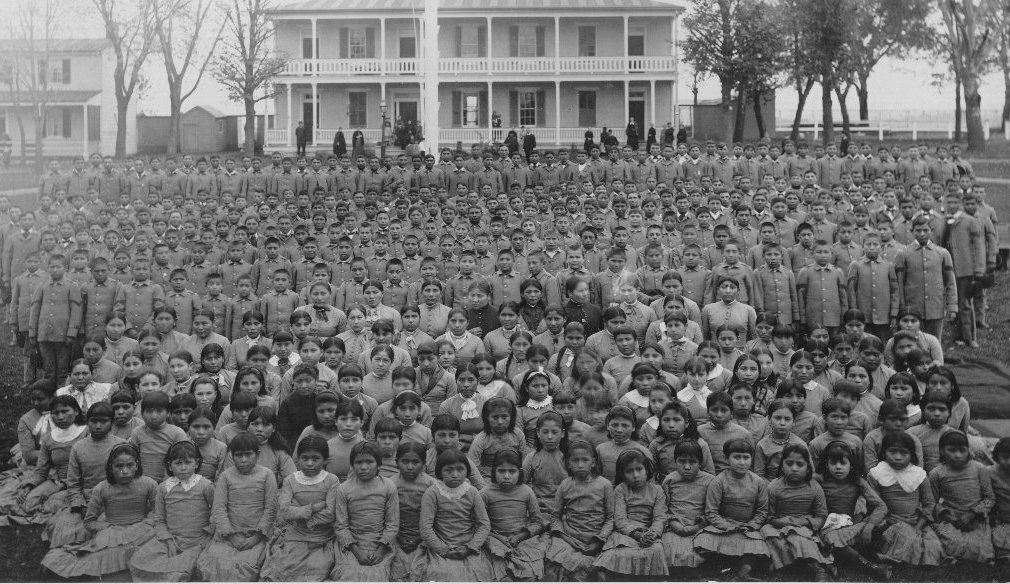
Infamous for its philosophy “Kill the Indian, Save the Man,” Carlisle Indian Industrial School aggressively assimilated over 10,000 children across 150 reservations. Each tribe embraced its own culture, but at Carlisle, children were made to conform to Anglo-American identities. Each child’s expression—or lack thereof—emblematizes Carlisle’s factory-esque stripping of individuality.
Alfred Fenton Messinger
Little Girls Praying Beside Their Beds, Phoenix Indian School, Arizona
June 1900
Photographic Print, B&W
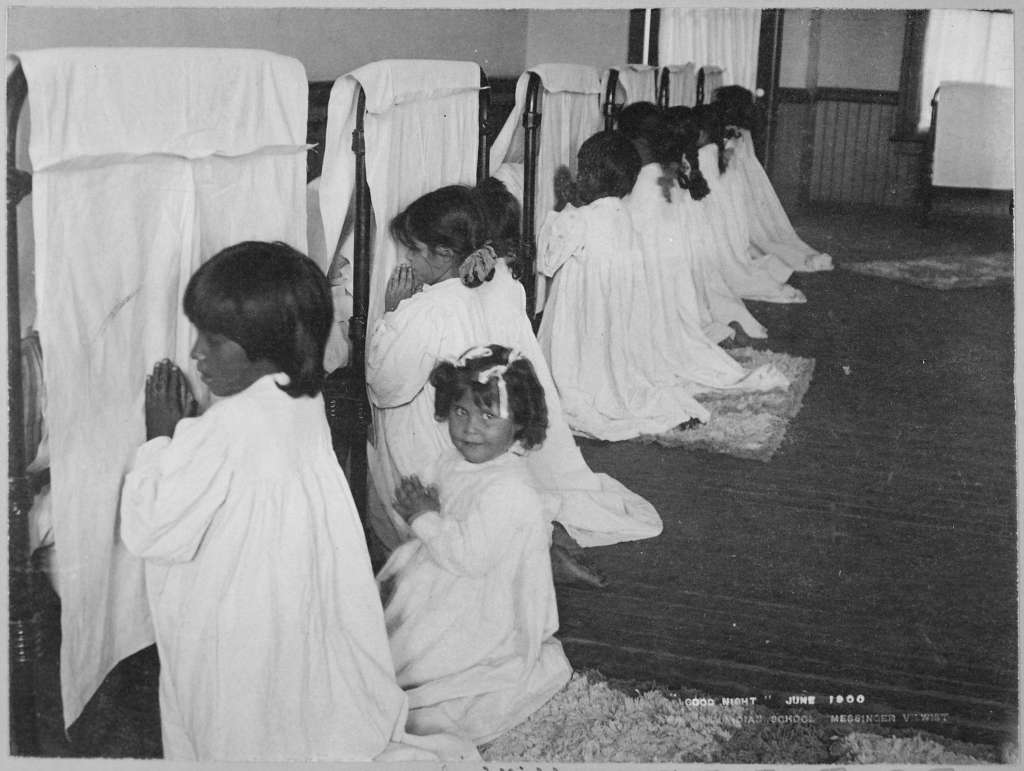
Rooted in white supremacy, American-Indian boarding schools indoctrinated students into Christianity. As students pray faced away, a young girl in the forefront smiles at the camera. One could question whether she represents the “ideal” student for others to emulate, as she appears actively, happily engaged with the religious proselytization.
John N. Choate
Indian School Students and Staff Working on Roof of a Building
1880
Photographic Print, B&W

Under the pretext of education and industry, American-Indian boarding schools exploited their students through heavy manual labor. Child labor aided in school building construction and restoration. Broadly, boarding schools not only deprived Native Americans of their cultural heritage, but also fueled their integration into society as the subordinate, working class.
Paul A. Yates, James R. Humer, Russell D. Smith, William B. Caroll
Cemetery at Carlisle Barracks
1935
Photographic Print B&W

While some students defeatedly accepted colonization efforts, many fought to retain their heritage. In turn, they experienced physical abuse, sexual violence, and starvation. Even compliant children faced fatal dangers, as hundreds died of diseases like tuberculosis, and smallpox. A graveyard outside Carlisle Indian Industrial School underscores the schools’ deadly nature.
Further resources
For more information on Native American experiences at Carlisle and other boarding schools see: Zach Levitt, Yuliya Parshina-Hottas, Simon Romero, and Tim Wallace, “War Against the Children: The Native American Boarding School System – a decades long effort to assimilate indigenous people before they ever reached adulthood – robbed children of their culture, family bonds and sometimes their lives,” New York Times, Aug 30, 2023.
For more information about the Carlisle Indian Industrial School, see the Carlisle Indian School Digital Resource Center at Dickenson College and and the Carlisle Indian School Project.
For information on and advocacy about the legacy of these boarding schools see The National Native American Boarding School Healing Coalition. In particular, take a look at their Interactive Digital Map of Indian Boarding Schools.
 Savitri Maya Kunze