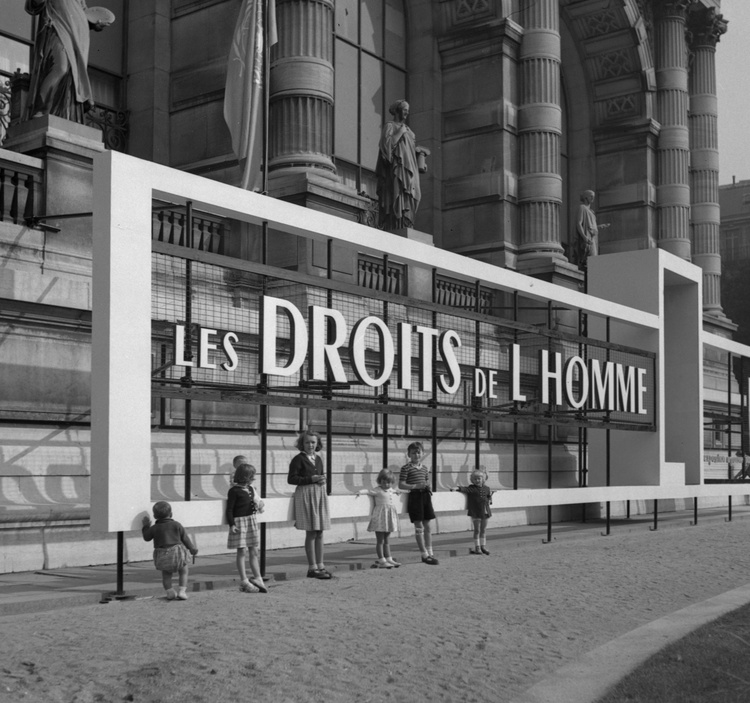
We began the term by thinking about how to define and visualize universal human rights. We did so by analyzing the UN Charter, the UDHR, and the resulting exhibition curated and disseminated by UNESCO.
As we looked at the UNESCO Human Rights Exhibition, we thought about:
- the historical narrative that the exhibition constructed,
- its main message about the history,
- how it represented the contributions of different nations
- how the media descriptions related to the images and shaped how the viewers experience of the individual images and of the exhibit as a whole.
For the final project, we return to these questions. You have the option to work independently or in a small group to curate five pieces of media that introduce your viewer to the ideas we’ve explored in the first part of Human Rights in World Civilization. You can either use the media to think about the course as a whole or focus on a subsection of what we’ve discussed this term.
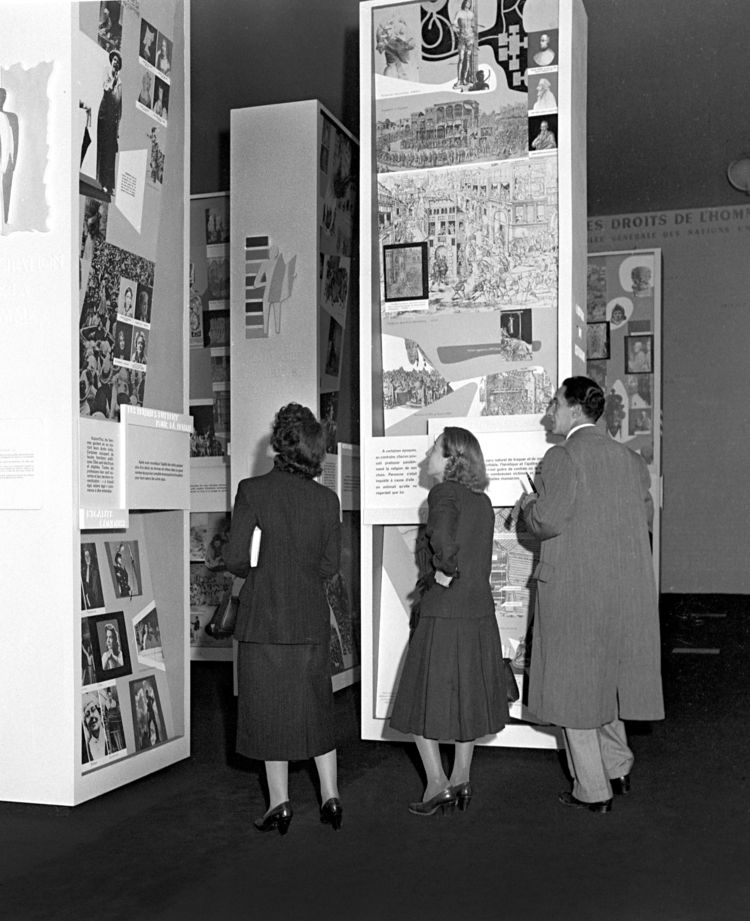
UNESCO Human Rights Exhibition
Installations at The Human Rights Exhibition, Musée Galliéra, Paris, 1949.
Image courtesy of The Human Rights Exhibit Project.
Media Selection
If you are working individually you will select five pieces of media. If you are working in a group, meet with me and we will discuss the appropriate number of media for your group.
The media you choose can range from archival images to creating individual TikTok videos or Instagram stories/reels. If the media you use are not your original work or incorporate other people’s work, please cite each piece appropriately and include a URL. You should not reuse material we have already analyzed in the class.
Sample media selection
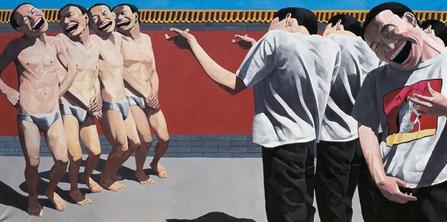
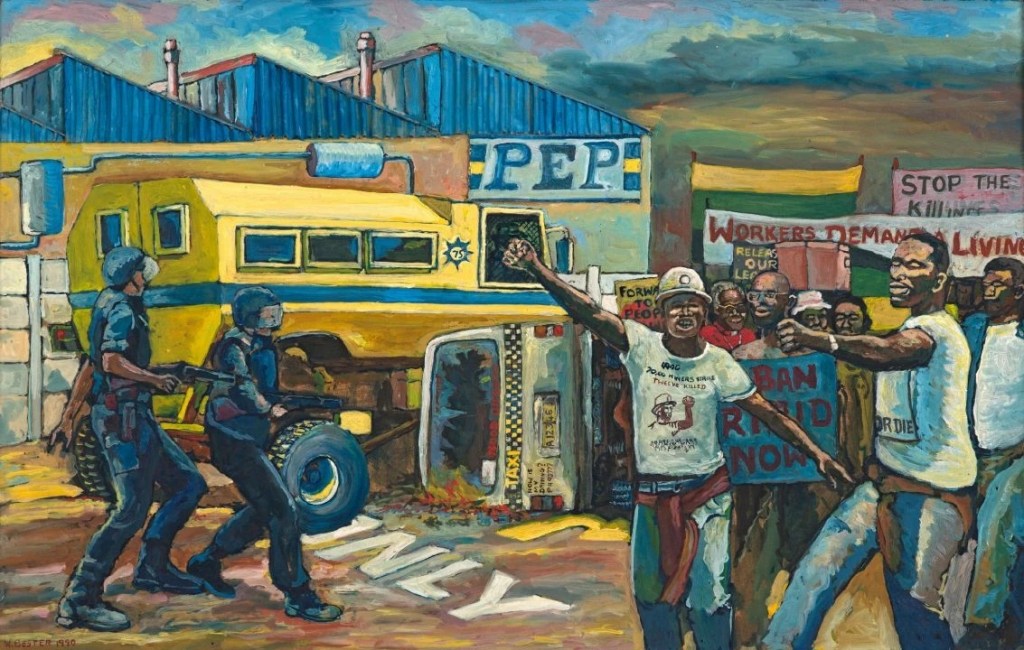
Alasdair Greenland selected the following pieces for their curation.
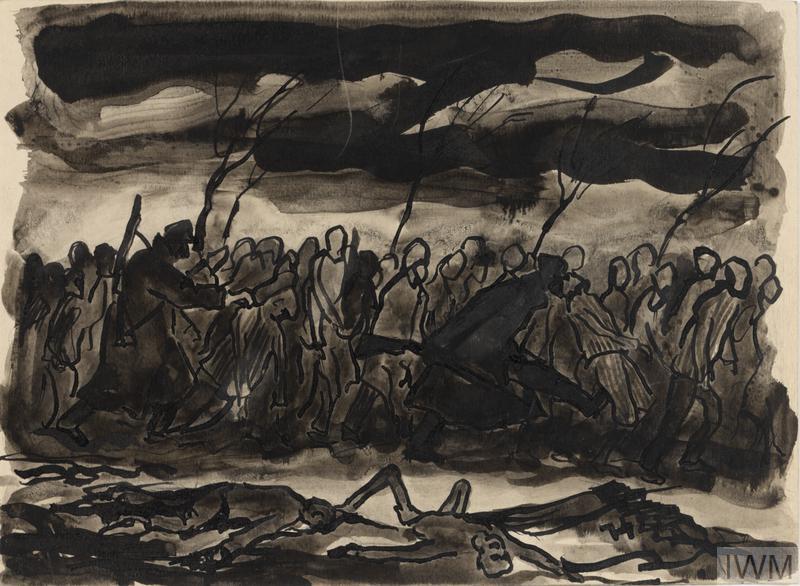
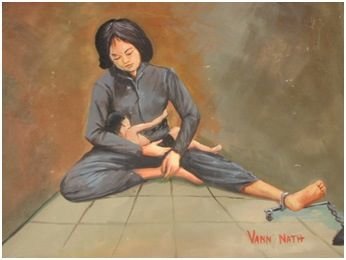
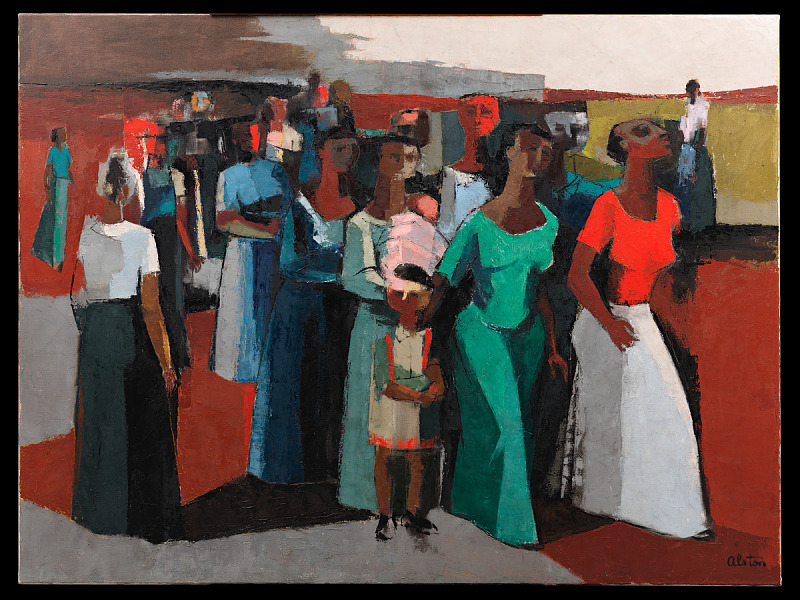
Curatorial Statement
Each set of media will be accompanied by a curatorial statement (200-300 words, 2-3 paragraphs).
As Elizabeth Rossiter writes in her guideline for curatorial statements:
Your curatorial statement is a great opportunity to help guide the way the public perceives your exhibition. It’s a chance to communicate directly with viewers, help them understand your point of view, and get them excited and curious about the work they’re about to experience.
I’ve slightly adapted Rossiter’s guidelines for the purposes of this assignment and our class:
The statement should be about 200-300 words and 2-3 paragraphs. It can be helpful to follow a basic structure—for example, using the first paragraph to establish the overall premise of the exhibit, the second to illustrate the range of artists’ approaches with examples, and the third to suggest the wider significance of your theme. If there’s a particular work that was especially instrumental in the way you thought about the exhibition, it might be interesting to describe that work in depth to draw the viewer into your thought process. Some curators also write a supplementary handout that describes each work in the show in some detail.
You should also think about the style of the statement. There are multiple audiences for your exhibition: the class, the University of Chicago community and the wider public. You want to be specific enough when articulating your agenda to engage the class and the UC community, but avoid using the kind of human rights or art-world jargon that might alienate a general audience. For instance, if there is a specific term that’s essential to the theme of the exhibition, make sure to define it in your curatorial statement. A thoughtful consideration of your audience can often help you articulate your ideas more clearly.
In general, you want an informative and persuasive tone, somewhere in between an academic paper and a newspaper article. That means no use of the word “I” or first-person observations.
Please refer to the examples Rossiter uses to give you an idea of what to think about.
Sample curatorial statement
Curatorial Statement produced by Esther Kassel, Disha Mohta, and Charlie Ortega Martinez for their curation, “Missing Persons: Media Depicting Erasure Under Tyrannical Regimes”
The exhibit, “Missing Persons: Media Depicting Erasure Under Tyrannical Regimes,” examines the various ways in which oppressed individuals and their circumstances are “erased” from existence, most commonly for political suppression or genocide in the most severe of cases. Tyrannical regimes of the past and present exhibit political and social exclusivity and violence against those that threaten the legitimacy and power of the state.
The first example of erasure under tyrannical regimes is political censorship. Media #1 displays USSR leader Josef Stalin to the left of a secret police official Nikola Yezhov; Yezhov is subsequently “erased” from the image entirely. In Media #5: “The Tlatelolco Massacre,” imprisoned revolutionaries opposing the Institutional Revolutionary Party (PRI) are depicted standing in a line before their identities are entirely obscured. Media #6: “Las Madres de la Plaza de Mayo” presents a crowd holding images of the thousands of children ‘disappeared’ by the Argentinian government during Operation Condor. Tyrannical regimes further employ erasure when suppressing evidence of genocide. Both Media #3: “Sonderkommando: No. 281” and Media #2: “Cambodian Man Smiling” depict erasure, although distinctly. The former depicts the Nazis targeting an ethnic group, and the latter portrays the suppression of an entire socioeconomic class by the Khmer Rouge. Finally, the last example of erasure is utilized in Media #4: “Obituary” at the University of Chicago for public recognition of murdered Palestinian civilians.
The “erasure” of groups or individuals is a by-product of the oppressive nature of tyrannical regimes. More generally, to acknowledge these “missing persons” and to understand the context of their oppression through these revealing photographs is a critical aspect of how people today must approach these regimes. The following photographs only reveal a select few examples of where oppressive regimes failed to fully “erase” their atrocities. When viewing the photographs, consider what is still left unseen–in the moment or simply forever.
Artwork, object, or media descriptions
After selecting your media, you will also include descriptions of each piece. Each item description should be concisely written (25-50 words, not including the title of the media, the medium, the creator, and the date).
TheExhibitTeam notes in their overview of how to write artwork or object descriptions:
Artwork or Object Descriptions are the blurbs which accompany each of the artworks or objects in your exhibition. They are just like the wall labels which are pinned next to each artwork or object in an offline exhibition. On The Exhibit, Artwork or Object Descriptions are automatically accompanied by the artwork’s title, manufacture date, medium, and size, as well as the artist’s name and a link to their biography.
As you write your descriptions, keep these tips from TheExhibitTeam in mind:
1. Don’t make descriptions chronological
You have to remember that even the most diligent visitors aren’t stopping on every artwork/object and reading every description. So, we recommend making each artwork/object description stand alone and able to be read independently of any others, because as soon as visitors read a description that assumes they’ve read a previous one, they end up confused and frustrated.
2. Make it Beneficial
Visitors to your exhibition are looking to find something out when they read your descriptions. If you provide something beneficial to them, an insight into the artist’s creative practice, what the artwork imagery means, or the historical significance or story of the object, you will hook them in. And once they’re hooked, they’ll delve deeper into your exhibition, read more of the other descriptions, look closer at your images and maybe even buy a piece if you have ‘for sale’ works in your exhibition.
3. Tie in the Big Idea
The Big Idea which you introduce in your Curatorial Statement can’t just appear just once in the introduction—it has to be a thread that weaves its way through the whole exhibition. This links all the artworks together and creates an overall sense of purpose. Visitors will also be able to follow and make sense of your visual narrative from the first artwork/object to the last artwork or object in your exhibition if you do this.
4. Be concise
…
With Artwork or Object Descriptions, shorter is definitely better, so make sure you get straight to any points you are making. If you’re referencing a historical period, art movement or artist, maybe add a short sentence explaining what or who this is. That way your visitors with art or historical knowledge are reminded and those new to your exhibitions are able to learn something which helps them understand your artwork and objects.
The Exhibition
Medium for Exhibit
Finally, you will take your media, the curatorial statement, and media descriptions together to present a mini exhibition. Your exhibition should not be in the form of a traditional class presentation (i.e. a PowerPoint) but rather take into consideration how your viewers relate to the images you’ve selected as a whole. I’d encourage you to consider how your viewer will be oriented toward your exhibit, including the descriptions.
You can choose to present your media either digitally or on paper. If you choose to present it on paper, consider looking into UC graphic arts, where you can print posters (see: https://www.graphicarts.uchicago.edu/large-format-prints). If you choose to present digitally, think about how to allow viewers to move through the different pieces in an organic manner. This might mean setting up multiple laptops or tablets for viewing, or using a digital curation space, like Art Placer or The Exhibit (which may offer some kind of free trial).
Sample Curation 01
Locked In and Out: Where Human Rights Do Not Reach
Curated by Sophie Tedesco, Felicia Su, and David Zhu
1. Curatorial Statement; 2-7. Images with descriptions (further information about creators on back side of each image) and interactive questions on the right of each image; 8. QR code for sources
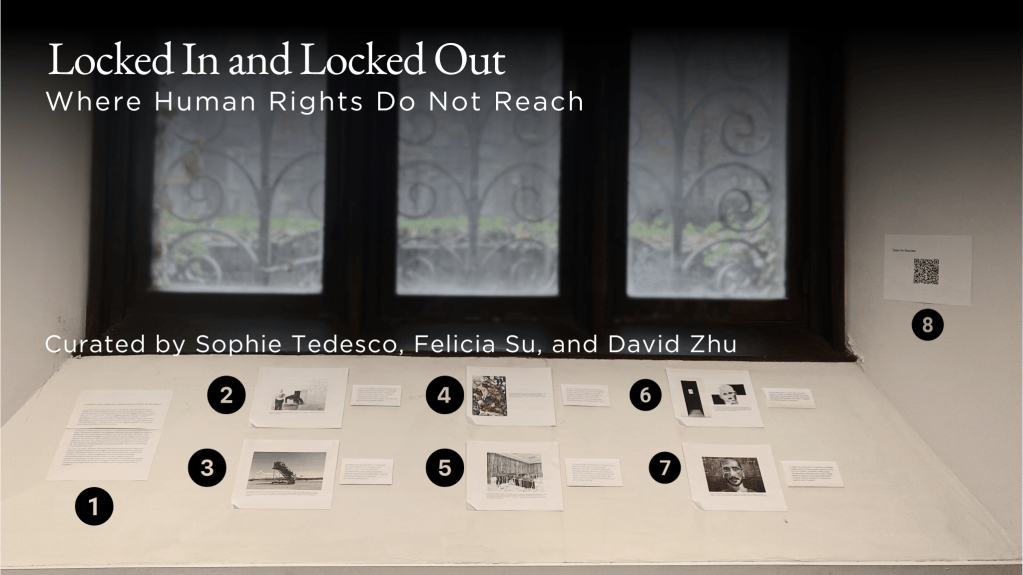
I’ve digitized the elements of their exhibit with their original text here.
Sample Curation 02
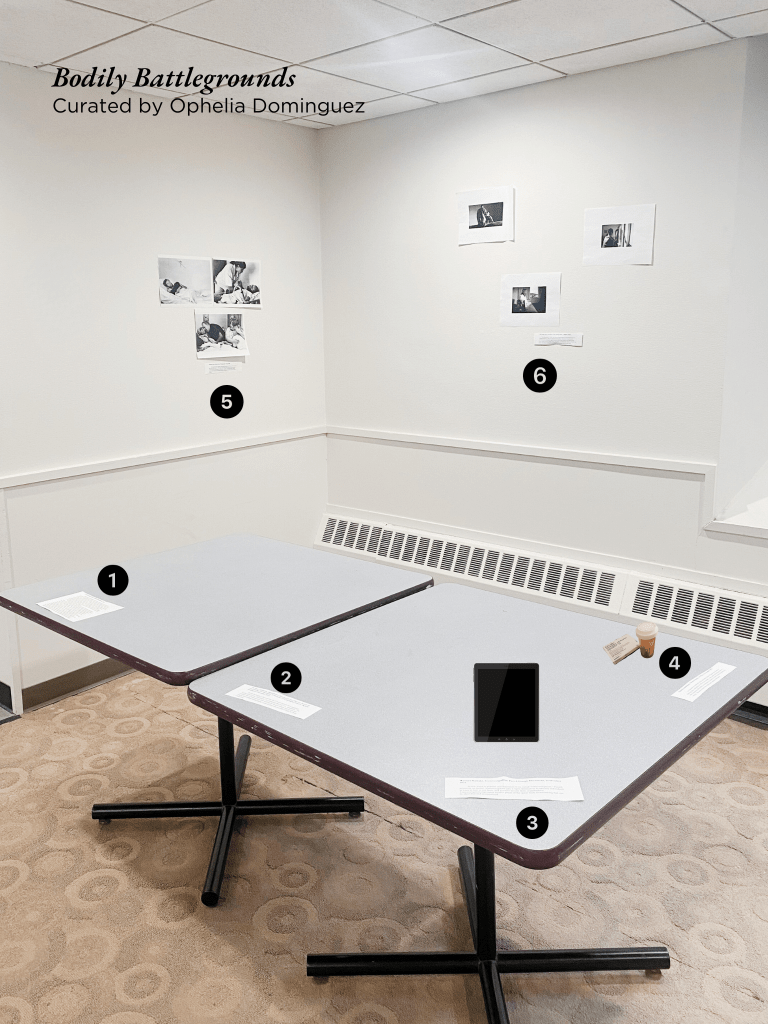
Bodily Battlegrounds
Curated by Ophelia Dominguez
1. Curatorial statement; 2-4. interactive media; 5-6. two-dimentional media
Sample Curation 03
Undercurrents: The Silent Impact of Everyday Choices
Curated by Tim Lu & Faye Dai
Follow link to virtual gallery.
Sample Curation 04
(Un)Civil Education
Curated by Aika Goel & Kayla Rubenstein
1. Curatorial statement; 2-6. two-dimentional media
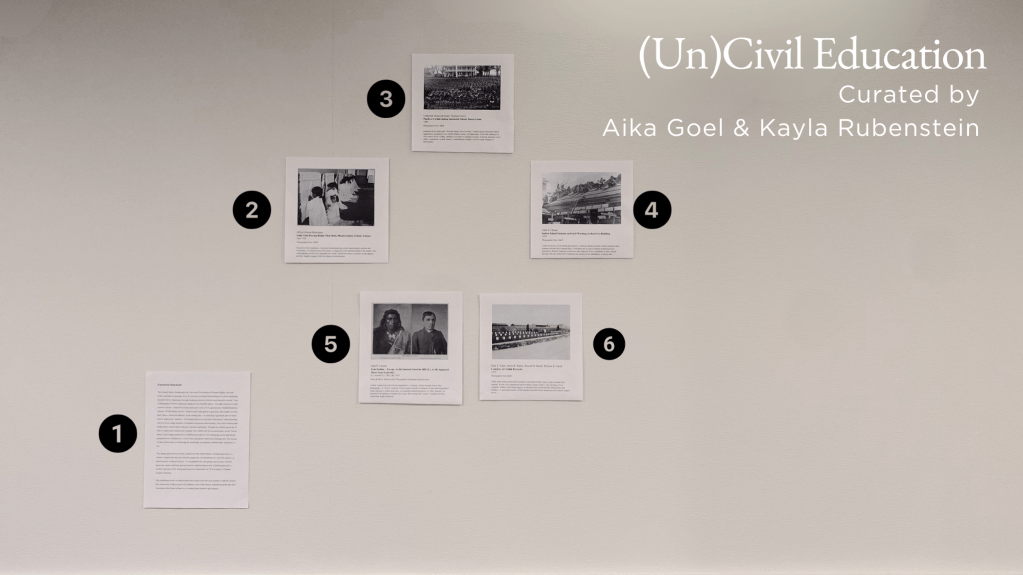
I’ve digitized the elements of their curation with their original text here. I provided additional links to resources on their topic.
Set-up
Make sure you have enough time to adequately assemble the exhibit, whether that means arriving early to class or setting it up in advance. We will discuss set-up logistics closer to the exhibits.
Verbal introduction
To further orient the class your exhibition, you offer a brief oral introduction (5 minutes) to the class. The introduction might take the form of a synthesis of your curatorial statement and personal reflection. If you’re working in a group, each member should contribute in some discernable way to the introduction.
Viewing and class discussion
After everyone introduces their exhibit, the class will have time to examine it (10 minutes). The class will then have the opportunity to ask questions, and engage in a discussion that the exhibit curators will lead (15 minutes).
Personal reflection
You will also write a 1000-word personal reflection explaining your curatorial choices and how they relate to the readings we’ve covered this quarter. Unlike your curatorial statement, your personal reflection should directly acknowledge and incorporate class material. It should be organized around an argument and draw substantively upon at least 5 readings or media we’ve covered this quarter in class to substantiate that argument.
Further resources
Please check out the following resources for more guidance on writing the curatorial statement and media descriptions (each page may refer to them slightly differently, but they all correspond with the same general idea):
- Director of Arts, “Writing Exhibition Texts,” Arts at Carlton, Carlton College, https://www.carleton.edu/arts-director/exhibitions/exhibition-planning/texts/
- “Writing on the Wall,” Harvard Art Museums, May 5, 2015, https://harvardartmuseums.org/article/writing-on-the-wall
- “Think Like a Curator: How to Descign an Exhibition,” The Art Gallery, University of Maryland, https://artgallery.umd.edu/sites/artgallery.umd.edu/files/lesson-plans/Think%20Like%20a%20Curator.pdf
- Smithsonian, Smithsonian Institution’s Guide to Interpretive Writing for Exhibition, September 2021, https://exhibits.si.edu/wp-content/uploads/2021/09/SI-Guide-to-Interpretive-Writing-for-Exhibitions.pdf
 Savitri Maya Kunze
#/media/File:Chineseart_Executionpainting.jpg)